Why Cannabis Brings Attention to the Present Moment: What It Shares with Mindfulness


Among the effects people describe after using medical cannabis, one of the less obvious but consistently reported is a shift in where attention goes. From personal experience and observation across Bangkok and Pattaya’s dispensary scene: thinking about what comes next, or replaying what already happened, becomes less automatic — and what’s happening right now becomes more present.
This is the same territory that mindfulness practice works in, which is what makes the overlap worth examining. Not to claim that cannabis is a mindfulness practice — it isn’t — but to understand the shift in attention that some people experience, what’s actually changing, and where the comparison holds and where it breaks down.
1: Why Cannabis Sometimes Shifts Attention Toward the Present
The shift toward present-moment awareness that some people report after cannabis use isn’t a deliberate achievement — it happens as a consequence of changes in how attention and thinking are organized. From personal experience: the most noticeable version of this is the quieting of the background mental activity that normally runs alongside whatever you’re doing. The planning, the reviewing, the anticipatory concern — that layer gets quieter, and what remains is more immediate.
What Changes in Attention
The most consistent personal experience: thinking about later or earlier becomes less automatic, and what’s present — sound, sensation, breathing — becomes more available to awareness. This isn’t a decision to focus on the present; it’s a reduction in the force that keeps pulling attention toward the non-present.
Mindfulness research has indicated that when attention shifts toward present-moment experience, ruminative and anticipatory thinking tends to decrease — not because it’s suppressed, but because present-sensory processing occupies the attentional bandwidth that rumination normally uses. (Source: Harvard University Research Team)
What Gets Observed in Others
From observation in dispensary settings: people whose attention has shifted toward the present show specific behavioral signs — slower conversational tempo, more orientation toward the surrounding environment, more attention to sensory details. They’re not trying to be present; they’re simply operating in a mode where present experience is more salient.
Research has indicated that cannabis compounds may influence attentional processing and sensory perception in ways consistent with a shift toward present-focused awareness, though the degree and character of these effects vary substantially across individuals. (Source: University of California, Los Angeles Research Team)
2: What “Returning to the Present” Actually Involves
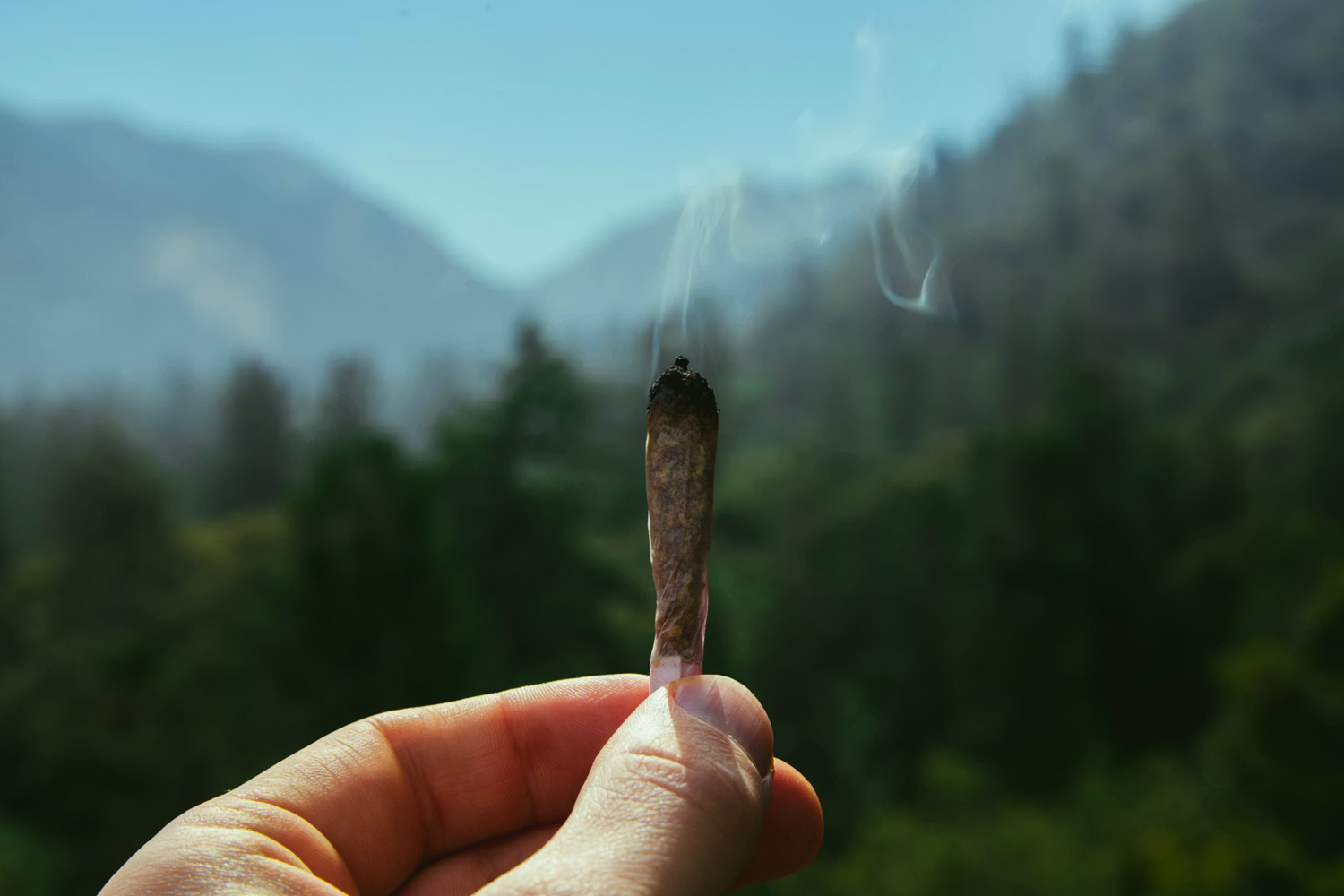
“Present-moment awareness” is an abstraction that becomes concrete when broken into its components. From personal experience and observation, what’s actually happening involves two distinguishable shifts: thinking becomes less oriented toward the non-present, and sensory experience becomes more prominent in consciousness.
Thought Becomes Less Future- and Past-Oriented
The most reliable personal experience: the automatic continuation of thought about what’s coming or what happened weakens. Thinking doesn’t stop — but the associative chain that normally carries thought away from the present into past review or future planning loses some of its momentum.
The result is that thought becomes more episodic rather than continuous — thoughts arise and can be followed, but the automatic background continuation that keeps pulling attention away from immediate experience becomes less insistent.
Mindfulness research has documented that attentional training toward present-moment experience reduces ruminative thinking — the automatic cycling through past and future — and that this reduction is associated with improved psychological stability. (Source: Oxford University Research Team)
Why Sensory Experience Becomes More Prominent
When abstract thought becomes less dominant, sensory processing occupies more of conscious attention. From personal experience: breathing, bodily sensation, sound, and physical surroundings become more available — not because they’ve changed, but because they’re competing with less ongoing thought for attentional resources.
This is the mechanism behind the “colors seem more vivid,” “music is richer,” “I noticed things I usually don’t” reports that come up regularly in cannabis accounts. The sensory experience itself may be somewhat enhanced by direct cannabinoid effects, but much of the vividness comes from the presence of attention that’s not simultaneously occupied elsewhere.
Research has indicated that attentional orientation toward body sensation supports present-moment awareness, and that sensory engagement reduces the pull of thought-based abstraction. (Source: University of Massachusetts Research Team)
3: What Cannabis and Mindfulness Have in Common
The overlap between cannabis-associated present-moment shifts and mindfulness isn’t coincidental — they’re affecting similar attentional processes, which produces similar phenomenological results. From observation: the commonalities are real enough to explain why people reach for the comparison, even though the mechanisms and contexts are different.
Reduced Evaluative Pressure During Experience
In both mindfulness practice and in cannabis-associated states, the running evaluation of experience — “is this good,” “is this right,” “what should I be doing” — tends to quiet. Experience is received rather than assessed. From personal experience: this is one of the clearest experiential overlaps. The evaluative commentary that normally accompanies experience runs at lower volume, and what remains is closer to direct contact with what’s present.
Mindfulness research has identified non-judgmental observation as a core component of present-moment awareness — the capacity to notice experience without immediately classifying it as good or bad, desirable or undesirable. (Source: Brown University Research Team)
Breath and Bodily Sensation Coming to the Foreground
Both states commonly involve increased awareness of breathing and physical sensation. In mindfulness practice, this is cultivated deliberately — the breath is chosen as an attentional anchor. In cannabis-associated states, it happens as a natural consequence of the attentional shift: when thought-based processing quiets, breath and body sensation become the most prominent available experiences.
From personal experience: in cannabis states where the present-moment shift is present, breathing becomes more noticeable without any intentional focus on it. It simply becomes available. This matches what research has described about breath awareness in mindfulness contexts — that it supports present-moment orientation by providing a stable, always-available sensory anchor. (Source: Stanford University Research Team)
4: Where Cannabis and Mindfulness Differ
The overlap is real but the differences are significant. Understanding where the comparison breaks down is as important as recognizing where it holds — particularly because conflating the two leads to misplaced expectations about what cannabis can reliably provide.
Intentional Versus Consequential
Mindfulness practice is, by definition, intentional. The practitioner directs attention to present-moment experience, notices when it wanders, and redirects it — repeatedly. This deliberate practice builds a capacity: the ability to choose where attention goes and to return it when it drifts. Cannabis-associated present-moment shifts are not chosen in this way. They arise as a consequence of a pharmacological state, not as the result of attention being directed.
This difference matters for what each produces. Mindfulness practice develops a transferable skill — the capacity for intentional present-moment attention that remains available outside the practice context. Cannabis-associated shifts don’t transfer in the same way; the state arrives with the substance and leaves with it.
Mindfulness research has consistently characterized the practice as involving intentional attentional control — a trained capacity rather than a drug-induced state. (Source: University of Massachusetts Research Team)
Controllability and Reproducibility
Mindfulness practice, with experience, becomes more controllable — the practitioner can increasingly access the attentional state when it’s needed. Cannabis-associated present-moment shifts are much less controllable. They depend on dose, strain composition, physical state, environment, and individual neurological response — all of which vary session to session.
From observation: the same cannabis product produces qualitatively different attentional states across different occasions for the same person. Sometimes present-moment awareness is pronounced; sometimes thought remains dominant; sometimes the experience produces scattered rather than settled attention. The reproducibility that comes with mindfulness practice doesn’t have an equivalent in cannabis use.
Research has documented large within-person variability in cannabis’s subjective effects across sessions. (Source: National Institute on Drug Abuse (NIDA))
5: Misunderstandings to Avoid
The cannabis-mindfulness parallel is productive as a conceptual frame but generates specific misunderstandings when taken too literally. From observation and experience, two come up most consistently.
Present-Moment Awareness Isn’t Guaranteed
Cannabis doesn’t reliably produce present-moment awareness. From personal experience: sessions where attentional quieting and sensory presence are strong alternate with sessions where thought increases, attention scatters, or the overall effect is cognitively activating rather than settling. The present-moment shift is one possible outcome of a variable experience, not a consistent consequence of using cannabis.
Mindfulness research has made the same observation about practice itself: attentional wandering during meditation is normal, not exceptional. The capacity to notice wandering and return is what’s being developed. In cannabis use, there’s no equivalent training structure — when attention wanders, it wanders. (Source: Oxford University Research Team)
Anxiety and Discomfort Are Also Possible
The same shift in attentional mode that sometimes produces settled present-moment awareness can also produce uncomfortable heightened self-awareness or anxiety. From personal experience: when physical state is already compromised, or when cannabis produces increased rather than decreased internal monitoring, the result is not settling but increased preoccupation with the experience itself.
This is consistent with what research has documented: cannabis can increase interoceptive awareness in ways that feel like calm for some people in some states, and like anxiety for others in other states. The cannabis-mindfulness parallel most obviously breaks down here — mindfulness practice, developed over time, tends toward equanimity; cannabis can go either way. (Source: National Library of Medicine (NLM))
6: How to Hold the Cannabis-Mindfulness Relationship Accurately

Cannabis and mindfulness share a phenomenological territory — present-moment attention, reduced evaluative pressure, sensory prominence — without sharing the mechanism, the intentionality, or the reliability that defines mindfulness practice.
The most accurate framing: cannabis sometimes produces a state whose attentional qualities resemble what mindfulness practice cultivates, through a completely different route, with considerably less consistency and controllability, and without generating any transferable capacity.
From personal experience: recognizing the overlap makes the cannabis experience more legible — you can identify what’s happening in attentional terms rather than just registering it as a vague feeling of calm. That recognition is useful. What’s less useful is expecting the consistency and control of an established practice from a pharmacological state that remains fundamentally variable.
Approaching cannabis with this understanding — noticing when the present-moment shift occurs, not demanding it when it doesn’t, and not attributing significance beyond what the state actually involves — produces the most stable and accurate relationship with what cannabis can and cannot offer in this direction.
Note: This article is based on content originally published on the Japanese edition of OG Times .