Can You Smoke Cannabis at Airports in Thailand? Rules, Risks, and What Travelers Should Know
1月. 25, 2026
Organic Gangsta Times
Kei

Thailand’s cannabis policy changes have led many travelers to wonder whether smoking cannabis is allowed at airports. While cannabis is no longer treated the same way it once was nationwide, its use in highly regulated public spaces such as airports remains unclear for many visitors.

Available information suggests that airport rules follow a different logic from general city regulations, and this difference is often overlooked. This section aims to clarify why confusion persists and how airports are commonly treated under current practices.

Can You Smoke Cannabis at Airports in Thailand

The short answer is that cannabis use at Thai airports cannot be understood in the same way as cannabis use in city areas. Airports operate under stricter public safety and operational rules, and these rules influence how smoking, including cannabis smoking, is handled. Understanding this distinction is essential before assuming that experiences outside airports apply inside them.

Why This Question Became Confusing After Legal Changes

After Thailand revised its cannabis regulations, public discussion largely focused on legality in everyday settings. This led many people to assume that cannabis use would be broadly tolerated wherever smoking areas exist. However, legal changes did not create uniform rules across all locations, especially in places governed by separate administrative frameworks.

Government agencies and public health bodies have continued to emphasize controlled environments and public order when addressing cannabis-related behavior (According to: Ministry of Public Health Thailand). Because airports fall under specialized oversight, the absence of clear, cannabis-specific messaging has contributed to ongoing misunderstanding rather than clarity.

Why Airports Are Treated Differently From City Areas

Airports are managed as high-security transportation hubs rather than ordinary public spaces. Smoking rules inside airports are generally designed to minimize disruption, ensure safety, and maintain operational efficiency. As a result, cannabis is often evaluated through existing public smoking and nuisance frameworks rather than through cannabis policy alone.

International aviation guidelines and public health recommendations consistently stress stricter behavioral controls in airport environments (According to: World Health Organization). This approach explains why actions tolerated in some city locations may draw attention or enforcement inside airports, even when no explicit cannabis ban signage is visible.

How Smoking Areas Are Actually Managed Inside Thai Airports

Smoking areas inside Thai airports are not operated as flexible or discretionary spaces. They are managed under strict rules intended to control behavior in high traffic, security sensitive environments. Understanding how these areas are designed and supervised helps explain why cannabis use is often treated cautiously, even when smoking areas are present.

Designated Smoking Areas and Their Intended Use

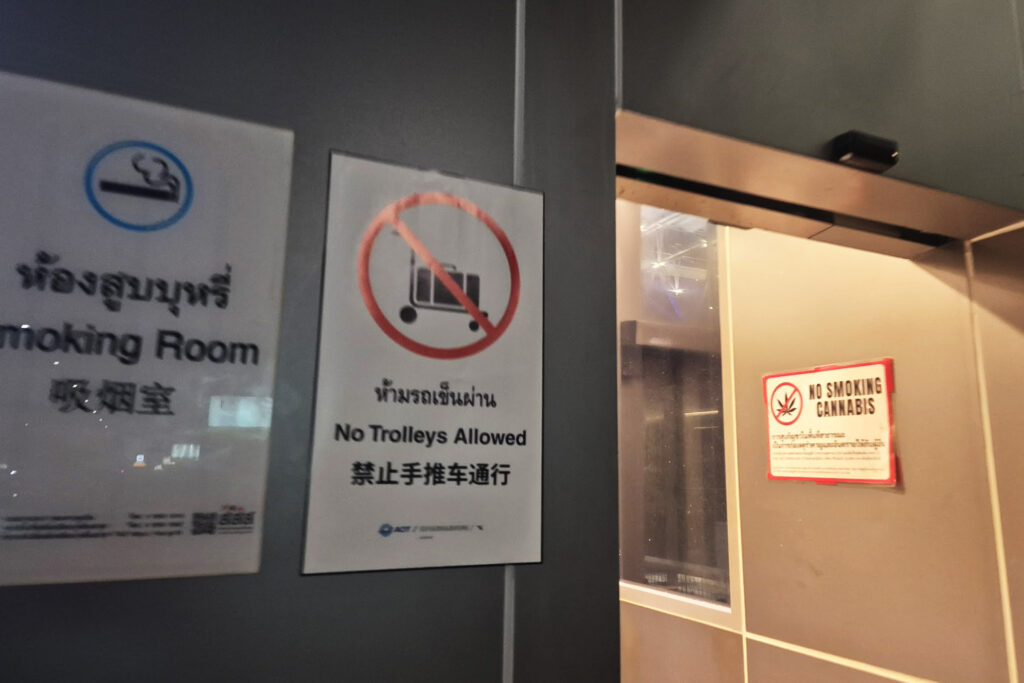
In Thai airports, designated smoking areas are clearly separated from general passenger spaces and are typically intended for conventional tobacco use. Based on on site observations and publicly available guidance, these areas exist to contain smoke, limit exposure to others, and maintain overall airport order.

Airport smoking policies are usually aligned with broader public health and safety frameworks rather than individual substance policies. Public health authorities continue to frame smoking areas as controlled exceptions rather than permissive zones (According to: Ministry of Public Health Thailand). This context is important when interpreting what is and is not implicitly allowed within these spaces.

How Cannabis Is Viewed Within Existing Smoking Rules

Cannabis is often assessed within the same operational framework as smoking behavior rather than as a separate legal category. This means that the presence of a smoking area does not automatically indicate permission to use cannabis, even if cannabis is legally discussed elsewhere in society.

From an administrative perspective, airport authorities tend to prioritize visible conduct, odor, and compliance with posted rules. International public health guidance supports this approach by emphasizing environmental control and minimizing disruption in shared spaces (According to: World Health Organization). As a result, cannabis use may attract attention or intervention if it is perceived to conflict with the intended purpose of smoking facilities.

What Official Notices and Enforcement Tend to Focus On

Official notices and on site enforcement at Thai airports tend to emphasize conduct within public spaces rather than cannabis policy itself. The focus is usually placed on maintaining order, safety, and compliance with posted rules, especially in areas where large numbers of travelers pass through in a limited time.

Rather than addressing cannabis as a separate category, airport guidance often frames expectations through existing public smoking and nuisance regulations. This approach reflects how airports are managed operationally rather than how cannabis is discussed in broader legal debates.

Penalties Mentioned in Airport Smoking Areas

In designated smoking areas at Thai airports, posted notices often reference penalties related to improper smoking behavior. These notices may include potential fines or other legal consequences when rules are violated. Such penalties are generally linked to public smoking regulations and airport specific ordinances, not to personal possession alone.

Publicly available guidance from Thai authorities indicates that enforcement in controlled public spaces can include monetary fines or further legal action depending on circumstances (According to: Ministry of Public Health Thailand). While exact outcomes may vary, the presence of penalty notices signals that smoking areas are closely monitored environments rather than informal spaces.

Why Cannabis Is Usually Addressed Under Public Smoking Rules

Cannabis is commonly addressed under public smoking rules because airport authorities prioritize observable behavior over substance classification. From an enforcement perspective, smoke, odor, and compliance with posted instructions are more actionable than legal nuance.

International public health frameworks support regulating smoking behavior in shared transportation facilities to reduce exposure and disruption (According to: World Health Organization). This explains why cannabis use, even when discussed as legal elsewhere, may still fall under general smoking enforcement within airports.

As a result, travelers may encounter enforcement actions that feel inconsistent with city experiences, even though they align with how airports are administratively managed.

Situational Risks Travelers Often Overlook

When considering cannabis use at Thai airports, many travelers focus on written rules while underestimating situational factors. Airports are dynamic environments where context can influence how the same behavior is perceived. This makes outcomes less predictable than in everyday city settings.

Understanding these situational risks helps explain why some travelers report no issues, while others encounter warnings or penalties under similar circumstances.

Why Past Experiences Do Not Guarantee Future Outcomes

Some travelers rely on past experiences, such as having smoked in an airport without consequences before. However, a previous lack of enforcement does not ensure the same response in the future. Airport operations, staffing, and enforcement priorities can change without notice.

Public authorities generally stress that compliance is assessed at the time of the behavior, not based on precedent (According to: Ministry of Public Health Thailand). This means that what went unnoticed once may be addressed differently on another occasion, even at the same airport.

How Timing, Crowds, and Staff Judgment Can Change Responses

The response to smoking behavior can vary depending on timing and surrounding conditions. During peak hours or periods of heightened security, staff may be more attentive to rule enforcement. Crowd density, visibility, and individual staff judgment can all affect how actions are interpreted.

International guidance on managing public transport hubs emphasizes situational awareness and discretionary enforcement to maintain safety and flow (According to: World Health Organization). As a result, the same behavior may receive different reactions depending on when and where it occurs within the airport.

These variables make it difficult to rely solely on written rules without considering the broader context.

Common Misunderstandings That Lead to Trouble

Many issues at Thai airports arise not from intentional rule breaking, but from misunderstanding how rules are applied. Assumptions based on everyday city experiences often fail to account for how airports function as controlled public spaces. Clarifying these misunderstandings can help reduce unnecessary risk.

Why City Experiences Do Not Apply to Airports

In city areas, cannabis use is often interpreted through local norms, shop guidance, or informal tolerance. Airports operate under a different framework. They are governed by transportation safety, crowd management, and operational efficiency rather than neighborhood level discretion.

Thai public authorities consistently distinguish between general public spaces and high control facilities when applying behavioral rules (According to: Ministry of Public Health Thailand). Because of this distinction, behavior that draws little attention in city settings may be treated more strictly inside airports, even when no new law has been introduced.

How “Not Clearly Prohibited” Is Often Misinterpreted

Another common misunderstanding is interpreting the absence of explicit prohibition as implicit permission. In regulated environments like airports, allowed behavior is often defined by posted instructions rather than by legal silence.

Public health and transport guidance generally emphasizes compliance with on site rules and staff directions over personal interpretation (According to: World Health Organization). As a result, relying on what is “not clearly prohibited” can lead to friction when actual expectations are communicated through signage or verbal instruction.

Recognizing this difference helps explain why some travelers encounter warnings or penalties despite believing they were acting within the rules.

What Travelers Should Consider Before Acting at Thai Airports

Before taking any action related to cannabis at Thai airports, travelers may benefit from shifting their focus away from general online information and toward what is happening on site. Airports function through real time instructions and localized management rather than broad legal interpretation. Recognizing this distinction can help avoid unnecessary attention or misunderstandings.

Observing Local Instructions Over Relying on Online Information

Online articles, forums, and personal accounts often describe past experiences, but these do not always reflect current airport practices. Information found online may be outdated, incomplete, or specific to a different location or time.

Public agencies frequently emphasize that travelers should rely on official notices and posted instructions within controlled facilities (According to: Ministry of Public Health Thailand). In practice, observing signage, announcements, and staff guidance provides more reliable direction than assuming consistency with previously shared experiences.

Why Following On Site Guidance Matters More Than Assumptions

At airports, compliance is often assessed based on immediate behavior rather than intent. Following on site guidance helps demonstrate cooperation and reduces the likelihood of escalation, even when rules appear ambiguous.

International health and transport organizations consistently stress adherence to local instructions in high traffic environments to maintain safety and order (According to: World Health Organization). This approach explains why staff directions may override personal assumptions about what should be acceptable.

By prioritizing situational awareness and official guidance, travelers may navigate airport environments with greater clarity and fewer risks.

What We Can Conclude About Cannabis Use at Thai Airports

After examining current practices, public guidance, and situational factors, it becomes clear that cannabis use at Thai airports cannot be reduced to a single rule. The way cannabis is treated depends less on its legal status and more on how behavior is managed within airport environments. This distinction helps explain why experiences can vary and why confusion persists among travelers.

Rather than relying on simplified interpretations, understanding how airports prioritize order and compliance provides a more accurate framework.

Why There Is No Simple Yes or No Answer

There is no universal permission or prohibition that applies in all situations at Thai airports. Airport authorities typically apply existing public smoking and conduct rules rather than issuing cannabis specific guidance. This approach means that outcomes may differ based on location, timing, and enforcement priorities.

Public health organizations emphasize flexible management of shared spaces to maintain safety and minimize disruption (According to: World Health Organization). As a result, attempting to apply a single yes or no answer to cannabis use at airports does not reflect how these environments are actually managed.

A Practical Perspective for Reducing Unnecessary Risk

From a practical standpoint, reducing risk involves understanding context rather than testing boundaries. Paying attention to signage, staff instructions, and the immediate environment is often more effective than relying on assumptions.

Thai public authorities continue to stress compliance with local rules in controlled public facilities (According to: Ministry of Public Health Thailand). By approaching airport settings with caution and situational awareness, travelers may avoid misunderstandings and unnecessary complications.

In this sense, cannabis use at Thai airports is best approached not as a legal debate, but as a matter of respecting the specific operational context of the space.

Cannabis Use at Thai Airports: What Travelers Should Understand

Current practices suggest that cannabis use at Thai airports cannot be judged through a simple legal lens. While cannabis regulations in Thailand have changed, airports continue to operate under strict public space management frameworks. In these environments, behavior is assessed based on smoking rules, safety considerations, and on site instructions rather than general cannabis legality.

Available information indicates that designated smoking areas are primarily intended for conventional tobacco use, and cannabis may still be addressed under public smoking or nuisance rules. Because enforcement can vary depending on timing, location, and staff judgment, past experiences or online accounts do not guarantee similar outcomes.

From a practical standpoint, travelers are generally advised to prioritize official signage, staff guidance, and situational awareness. Approaching Thai airports with caution and respect for local operational rules may help reduce unnecessary risk and misunderstandings.

Related articles