Where Can You Smoke Cannabis in Thailand? Practical Rules Visitors Use to Avoid Trouble
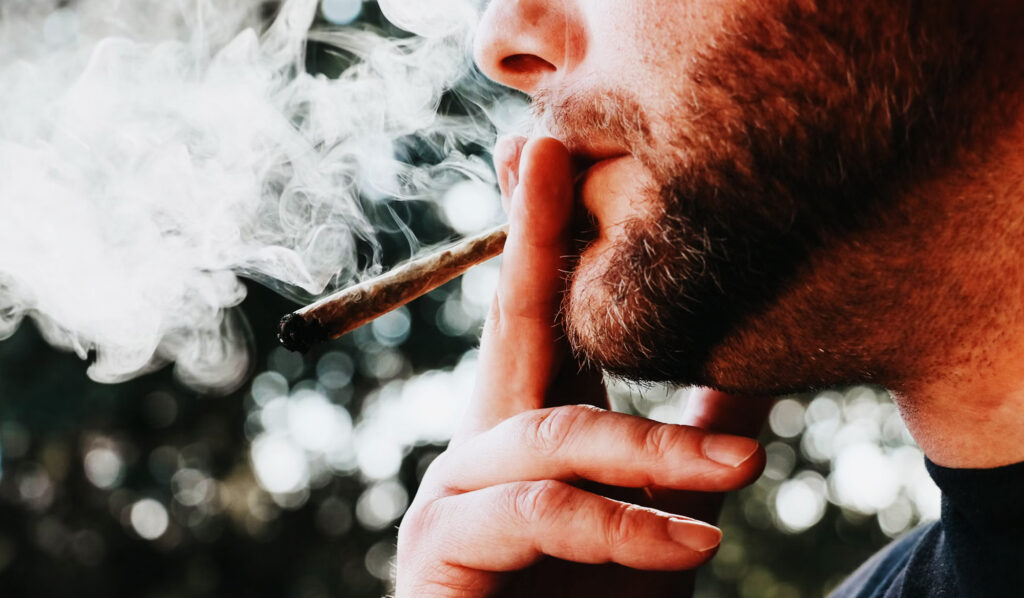

Thailand can look like a place where cannabis can be smoked anywhere because dispensaries are common and public use is sometimes visible. However, that impression may be misleading. After the 2022 shift, cannabis became “decriminalized” in a way that often feels permissive, but public smoking can still create problems when smoke or odor affects other people, especially in busy areas.
In practice, the difference between what appears normal on the street and what is formally acceptable is frequently described as a “gap.” For visitors, the safest approach is to assume that cannabis use is only low-risk in clearly permitted private spaces, and that public settings, commercial areas, and transport-related locations can trigger complaints, warnings, or fines.
This guide organizes where use is commonly treated as problematic, where it is sometimes tolerated, and how to reduce risk through location choice and simple etiquette.
Where Can You Smoke Cannabis in Thailand Without Getting Into Trouble?
In Thailand, it is easy to assume cannabis can be smoked “anywhere” because dispensaries are visible and some people smoke on the street. However, this appearance can be misleading. After the 2022 decriminalization, cannabis rules may look loose, but in practice the boundaries are often clearer than visitors expect. For travelers, the biggest risk is not understanding the difference between places that are commonly tolerated and places that are likely to trigger warnings, complaints, or fines.
In this guide, the key idea is simple: the safest approach is to decide where you will smoke before you smoke, rather than relying on what you happened to see in public. That shift alone is presented as a way to avoid most trouble, because many tourist problems come from mixing up “I saw someone do it” with “I am allowed to do it.”
「タイでは道端で医療大麻は吸えますか?」
答えはバレたら罰金。ですが、"タバコ"と同じで周り配慮して吸う分には問題ないと考える大麻愛好家が多いと言うのも現実です— Kei | 借金2000万抱える大麻盆栽家 (@smallnycer) December 25, 2025
What “safe enough” usually means for visitors
Here, “safe enough” does not mean officially approved everywhere. It means choosing locations that are described as less likely to create conflict based on how things are handled on the ground. The Japanese source text explains that visitors often get into trouble when they do not separate “places that tend to be accepted” from “places that tend to be treated as violations.”
In that framing, locations commonly treated as safer include hotel smoking areas, some balcony situations depending on hotel policy, certain dispensary-adjacent outdoor spaces, and private property. The reasoning is practical: these settings reduce visibility, reduce exposure to random complaints, and make it easier to control smoke and odor. By contrast, the text repeatedly positions public-facing areas as the most avoidable risk because a single complaint can quickly change the situation.
The main takeaway is that knowing the “allowed enough” place first prevents most tourist trouble. The article also emphasizes that even locals can misunderstand the gap between written rules and real-world enforcement, which is why travelers should rely on clear boundaries rather than assumptions.
Why public visibility is not the same as permission
Seeing people smoke in public is not the same as having permission to do so. The Japanese source warns that many tourists confuse “people are doing it” with “it is legal everywhere,” and calls this a major misunderstanding. Decriminalization reduced enforcement in some ways, but it did not remove restrictions on where smoke can be produced in public spaces.
The text also notes that enforcement outcomes can shift based on context: place, time, surrounding environment, and whether someone complains. That is why “I did it and nothing happened” is presented as a weak proof of safety. A visitor who smokes in a visible public area may simply have been lucky, and the same behavior can lead to warnings, hotel issues, or fines in another moment.
So the practical point is not to follow what looks normal on the street, but to choose a location where visibility and complaint risk are structurally lower. This is also why the article frames Thailand as “looking free” while still being “limited” in where cannabis can realistically be smoked without trouble.
Why Thailand Can Look “Anywhere-OK” Even When It Is Not
Thailand often feels permissive when it comes to cannabis because of what people see in daily life. Dispensaries are everywhere, and it is not unusual to notice someone smoking in public. This creates the impression that cannabis use is broadly accepted without restriction. However, the Japanese source text repeatedly stresses that this appearance does not reflect how rules are actually defined or applied.
The key issue is not that rules do not exist, but that the way rules are written and the way they are enforced do not always match. This mismatch is what makes Thailand look “anywhere-OK” on the surface, while still producing fines, warnings, and complaints for visitors who misunderstand the boundaries.
How the gap between written rules and street reality is commonly described
The article describes Thailand as a place where legal structure and on-the-ground behavior often drift apart. On paper, public smoking that produces odor or smoke can be treated as a public nuisance. In practice, enforcement may appear relaxed, especially in tourist-heavy areas, which gives the impression that rules are not taken seriously.
However, the text explains that this is not the same as permission. Instead, it is better understood as a situation where enforcement is selective, situational, and reactive. Complaints, visibility, and location matter more than the act itself. This is why even local residents can misjudge where smoking is actually tolerated, and why visitors are especially prone to mistakes.
The result is a cityscape where cannabis use looks normal, while the underlying boundaries remain intact but inconsistently enforced.
Why visitors often misread visibility as permission
Visitors often rely on visual cues. When they see others smoking without immediate consequences, they assume the behavior is allowed. The Japanese article identifies this as one of the most common misunderstandings among travelers. Visibility creates a false sense of legality, even though the legal framework has not changed in the way people assume.
The text also points out that many people who appear to smoke freely are operating within informal understandings: choosing low-visibility spots, times with fewer bystanders, or places where complaints are unlikely. Tourists who copy the behavior without understanding these conditions often expose themselves to risk.
In short, what looks acceptable in public is often the result of luck, context, or local knowledge, not actual permission. This is why the article emphasizes learning boundaries rather than following what seems normal on the street.
What “Decriminalized” Usually Means in Thailand’s Cannabis Context
In Thailand, cannabis is often described as “legal,” but the Japanese source text makes it clear that this is an oversimplification. The change that occurred in 2022 was decriminalization, not full legalization. This distinction is central to understanding why cannabis use still carries location-based and situational risks, especially for visitors.
Decriminalization reduced criminal penalties, but it did not create broad freedom of use. As a result, many restrictions remained in place under other laws, particularly those related to public order and health.
Why decriminalization is often not the same as full legalization
The article explains that decriminalization means cannabis was removed from the narcotics list, which significantly reduced arrests and policing pressure. However, it did not establish cannabis as something that can be used freely in public or without conditions.
Public smoking that produces smoke or strong odor is still regulated under public health rules, and enforcement can occur when complaints are made or when use is highly visible. This is why people can see cannabis being used openly in some places, yet still hear about fines and warnings in others.
In other words, decriminalization softened punishment but did not remove boundaries. This gap between expectation and reality is a major source of confusion for travelers.
How “medical use” is commonly treated as the formal basis
According to the Japanese article, Thailand’s cannabis framework is still officially framed around medical use. Medical purpose remains the formal justification within the legal structure, even though recreational use is widespread in practice.
This creates a dual-layer situation. On paper, cannabis is positioned as something tied to health and treatment. On the street, it is treated more casually. The problem for visitors is that enforcement and interpretation tend to fall back on the formal structure when issues arise.
As the article notes, this is why certain products, locations, and behaviors are treated more strictly than others. The “medical use” framing acts as a fallback rule, shaping how authorities respond when cannabis use becomes visible, disruptive, or contested.
Why Public Smoking Can Still Be Treated as a Problem
Even after decriminalization, smoking cannabis in public spaces in Thailand can still lead to fines or warnings. The Japanese source explains that this is not because cannabis itself is singled out, but because public smoking is regulated through general public health and nuisance laws.
In practice, enforcement focuses less on what is being smoked and more on whether smoke, odor, or behavior is considered disruptive to others.
How “public nuisance” framing is commonly applied to smoke and odor
Thailand’s Public Health Act includes provisions against actions that cause public nuisance, such as smoke, strong odors, noise, or dust in shared spaces. Cannabis smoke and smell fall under this category when they affect others, even though cannabis is no longer classified as a narcotic.
This means that streets, beaches, parks, and areas in front of buildings can all become enforcement targets if smoke or odor is judged to be disturbing. The Japanese article emphasizes that this rule applies broadly and is not cannabis-specific, but cannabis use is particularly noticeable due to its smell.
(According to: Thai Ministry of Public Health)
As a result, public smoking is not treated as “automatically allowed,” even if cannabis itself is decriminalized.
Why complaints and visibility can change outcomes
The article highlights that enforcement is often complaint-driven. Whether a situation becomes a problem frequently depends on visibility and whether someone reports it. If no one complains, use may appear tolerated. Once a complaint is made, the same behavior can result in warnings or fines.
Highly visible locations increase this risk. Tourists may assume that seeing others smoke openly means permission, but the Japanese text notes that this is often just a lack of immediate enforcement. Visibility raises the chance of complaints, and complaints trigger action.
This is why outcomes can differ dramatically depending on place, time, and surroundings, even when the behavior itself looks identical.
Places Commonly Treated as High-Risk for Smoking
Based on the Japanese source, certain locations in Thailand are consistently treated as high-risk for cannabis smoking, even after decriminalization. These places share one common factor: they are public, highly visible, and likely to generate complaints.
In these environments, smoking is frequently interpreted as a public nuisance rather than a private choice, which makes enforcement more likely.
Streets, parks, beaches, and other open public areas
Open public spaces such as streets, parks, and beaches are repeatedly described as the highest-risk locations. The Japanese article explains that any outdoor area where smoke or odor can spread to others is easily classified as a public nuisance under the Public Health Act.
Beaches and parks are particularly sensitive because they are shared leisure spaces used by families, tourists, and local residents. Even if smoking appears common, complaints from bystanders can quickly lead to police involvement.
(According to: Thai Ministry of Public Health)
The key issue is not whether cannabis is legal, but whether smoke affects people nearby.
Malls, stations, and transport-adjacent areas
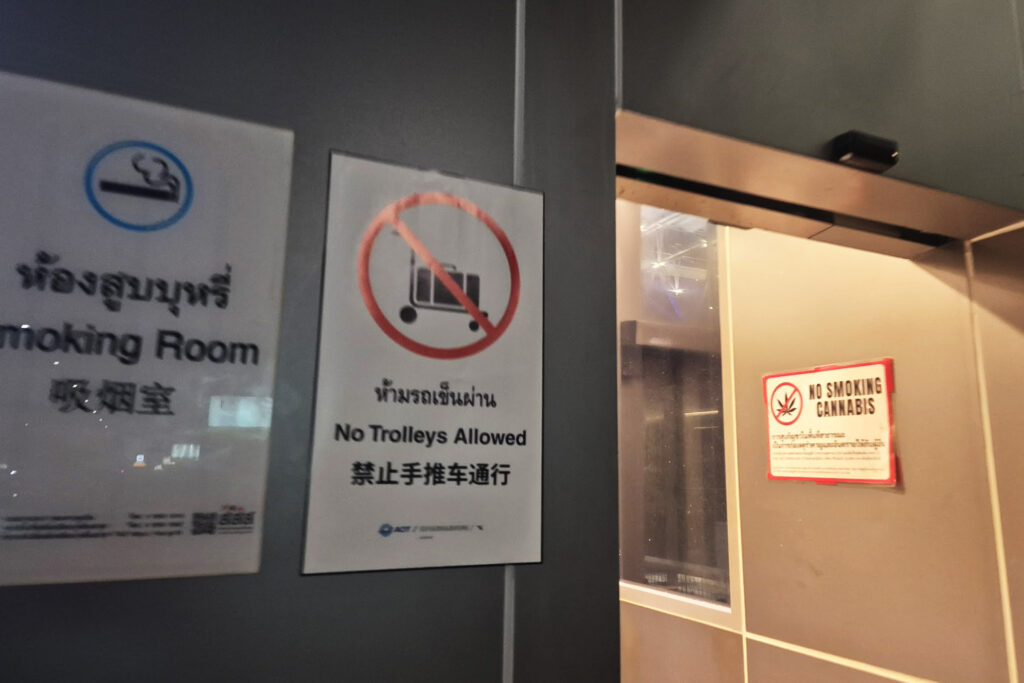
Shopping malls, train stations, and areas near public transportation are treated with stricter standards. These spaces are managed environments with clear no-smoking policies, and cannabis smoke is handled in the same category as tobacco or other prohibited smoke.
The Japanese source notes that stations and transit areas are also linked to safety concerns, crowd density, and constant monitoring. As a result, smoking in or near these locations is more likely to result in immediate warnings or fines, regardless of how casually others may behave nearby.
Restaurant fronts, cafe areas, and dense pedestrian zones
Areas in front of restaurants, cafes, and busy pedestrian streets are another frequent source of trouble. According to the article, smell-related complaints are most common in food-adjacent spaces, where cannabis odor is easily perceived as disruptive.
Even brief smoking in these zones can trigger complaints from customers or staff, leading to enforcement under public nuisance rules. The article emphasizes that many tourist problems originate not from police patrols, but from third-party reports made by nearby businesses or pedestrians.
In these locations, visibility and proximity to others sharply increase risk, even if smoking appears socially tolerated at first glance.
Places Often Considered Lower-Risk in Practice (Not a Guarantee)
In Thailand, there are locations that are often described as lower-risk in everyday practice, even though they are not formally designated as legal smoking areas. The Japanese source consistently emphasizes that “lower risk” does not mean permitted, guaranteed, or legally protected, but rather reflects how enforcement tends to work on the ground.
These spaces share common traits: limited public exposure, clearer boundaries, and reduced likelihood of complaints.
Hotel smoking areas and balcony situations (policy varies by property)
Hotel smoking areas and private balconies are frequently described as the most commonly used spaces by visitors. The article explains that many hotels treat cannabis similarly to tobacco in outdoor smoking areas, especially when smoke does not drift into shared spaces.
However, policies vary significantly by property. Balcony use is often tolerated in practice, but only when odor does not reach neighboring rooms. Smell-related complaints are identified as the main trigger for warnings or cleaning fees. The text makes clear that tolerance is based on operational discretion, not legal permission.
(According to: Thai Ministry of Public Health)
Private property: villas, terraces, and controlled outdoor spaces
Private property such as villas, houses, and controlled terraces is described as one of the lowest-risk environments in practice. The Japanese article notes that spaces fully under private control reduce visibility and third-party complaints, which significantly lowers enforcement risk.
That said, the article also stresses that nuisance rules still apply if smoke, noise, or disturbance affects neighbors. Privacy lowers exposure, but does not remove responsibility for managing smell and behavior.
Dispensary-adjacent spaces that are sometimes “allowed” on the ground
Some dispensaries provide outdoor or semi-open spaces where staff informally indicate that smoking is acceptable. The article clearly states that these areas are not legally authorized smoking zones, even if they appear designed for that purpose.
Their continued operation is described as a result of local tolerance, tourism pressure, and uneven enforcement. If complaints occur or inspections take place, these spaces can quickly become restricted. Visitors are advised to understand that permission is situational and dependent on the shop’s discretion rather than written law.
(According to: Thai Ministry of Public Health)
Hotel Use: The Most Common Source of Visitor Trouble
Among visitors, hotels are repeatedly described as the most common source of cannabis-related trouble in Thailand. The Japanese article consistently points out that most problems do not start with police enforcement, but with hotel staff responses to smell and complaints. This makes hotel use a higher-risk area than many travelers initially expect.
Why “room smoking” often triggers fees or warnings
Smoking inside hotel rooms is identified as the most frequent cause of penalties. Even in properties that appear tolerant, indoor smoking almost always violates hotel policy due to lingering odor and cleaning requirements.
The article explains that hotels commonly respond with cleaning fees, written warnings, or requests to vacate the room. These outcomes occur regardless of whether the substance is tobacco or cannabis, as odor removal and guest comfort are treated as operational issues rather than legal ones.
How smell and neighbor complaints commonly escalate issues
Smell is repeatedly described as the key trigger that escalates minor use into formal action. Neighbor complaints transform a private action into a public issue, which then obligates staff to intervene.
The text notes that even balcony use can become problematic if smoke drifts into adjacent rooms or hallways. Once a complaint is logged, staff responses tend to escalate quickly, moving from informal warnings to documented penalties.
(According to: Thai Ministry of Public Health)
How to confirm the practical smoking area without causing confusion
The article emphasizes that confusion often arises from how questions are asked. Directly asking whether cannabis is allowed in rooms can trigger immediate refusal. Instead, confirming designated smoking areas without specifying substances is described as a more practical approach.
By focusing on where smoking is generally permitted rather than on cannabis specifically, visitors reduce misunderstandings and avoid unnecessary attention. The text makes clear that staff guidance reflects internal policy boundaries, not legal authorization.
Dispensary Smoking Spaces: Rules, Signals, and On-The-Ground Reality
Cannabis dispensaries in Thailand are often perceived as places where on-site smoking is freely allowed. However, the Japanese article makes clear that dispensary smoking spaces exist within a gray zone shaped by policy signals and local practice. This gap between written guidance and daily operation is one of the most confusing points for visitors.
How “in-shop smoking” is commonly discussed under recent policy signals
Recent policy updates have been widely interpreted as discouraging or restricting recreational smoking inside dispensaries. Official announcements emphasize that dispensaries are intended for sales rather than consumption, especially outside a medical context.
At the same time, the article notes that these signals are often communicated indirectly. Rather than clear enforcement, policy changes appear as guidance, notices, or verbal instructions, which leaves room for inconsistent interpretation at the shop level.
(According to: Thai Ministry of Public Health)
Why some shops still look unchanged despite announcements
Despite policy signals, many dispensaries continue to look unchanged on the ground. Seating areas, semi-outdoor lounges, and casual smoking spaces are still commonly observed.
The article explains that this persistence is linked to Thailand’s broader enforcement pattern, where practice often lags behind formal announcements. Local authorities, tourism dependence, and the absence of immediate penalties contribute to a situation where shops maintain previous setups unless directly instructed to change.
How to choose a space that minimizes complaints and visibility
From the article’s perspective, the safest dispensary-associated spaces share three characteristics: limited visibility, good airflow, and staff guidance. Spaces that are semi-outdoor, separated from sidewalks, and explicitly indicated by staff are consistently described as lower-risk.
Conversely, fully enclosed indoor rooms, sidewalk-facing seats, or areas with heavy foot traffic are more likely to attract complaints. The key distinction is not whether smoking appears tolerated, but whether it avoids becoming noticeable to others.
Visitor Safety Rules That Reduce Risk the Most
Based on the Japanese article’s observations, visitor safety in Thailand’s cannabis environment depends less on legality labels and more on everyday behavior. Risk is most effectively reduced by following simple, conservative boundaries rather than copying what appears common on the street.
Use only clearly permitted private spaces
The article consistently frames private, clearly permitted spaces as the lowest-risk option. These include hotel-designated smoking areas, private villas, and controlled indoor or semi-outdoor spaces where smoking is explicitly allowed.
What matters most is not ownership, but clarity. If a space is not clearly marked or verbally confirmed as permitted, it should be treated as restricted. This approach aligns with how public nuisance rules are applied in practice.
(According to: Thai Ministry of Public Health)
Avoid public use even if others appear to do it
The article emphasizes that visibility does not equal permission. Even when public smoking appears common, outcomes often change once complaints occur or attention is drawn.
Public use remains the most unpredictable risk factor because enforcement is complaint-driven. Visitors are advised not to rely on what others are doing, as tourists are more likely to be questioned than locals in the same setting.
Control odor, noise, and visibility as a basic etiquette baseline
Across all environments, the article highlights etiquette as a practical risk filter. Strong odors, loud behavior, and visible smoke are the most common triggers for complaints.
Keeping cannabis use discreet, quiet, and low-odor significantly reduces the chance of intervention. This principle applies even in semi-allowed spaces, where tolerance often depends on not disturbing others rather than formal permission.
Why “Where You Smoke” Matters More Than Anything Else
Throughout the article, location consistently appears as the single factor that most strongly influences outcomes. In Thailand’s cannabis context, where use happens often matters more than what is used or how much. This is because enforcement, complaints, and social tolerance are all highly location-dependent.
How to think in boundaries instead of assumptions
The Japanese source frames risk management as a shift in mindset. Rather than assuming something is allowed because it looks common, visitors are encouraged to think in boundaries.
A boundary-based approach asks simple questions:
Is this space private or public?
Is permission explicit or only implied?
Would smoke, smell, or visibility affect others nearby?
If any boundary is unclear, the space should be treated as restricted. This way of thinking reflects how public nuisance rules are applied in practice, where ambiguity usually works against the user rather than in their favor.
(According to: Thai Ministry of Public Health)
How to enjoy cannabis while keeping risk low and situations calm
The article repeatedly suggests that enjoyment and safety are not opposing goals. Low-risk use is framed as calm, discreet, and situationally aware rather than permissive or experimental.
Choosing controlled spaces, limiting visibility, and respecting shared environments allows visitors to avoid unnecessary tension. This approach reduces the chance of complaints, misunderstandings, or enforcement actions, while keeping the experience aligned with local tolerance levels.
In short, the article positions location awareness not as a restriction, but as the foundation for a smoother, more predictable experience.
Why Understanding “Where You Smoke” Is the Safest Way to Approach Cannabis in Thailand
Across all sections, one pattern remains consistent. In Thailand, cannabis-related trouble is rarely determined by the product itself. It is far more often shaped by location, visibility, and surrounding context.
Although cannabis was removed from the narcotics list in 2022, this change did not create universal permission. Public nuisance rules, complaint-based enforcement, and unclear boundaries between allowed and restricted spaces continue to influence outcomes. This is why public smoking, even when commonly seen, can still result in warnings, fines, or conflict.
The article does not frame Thailand as either fully permissive or strictly enforced. Instead, it highlights a system where written rules and on-the-ground practice do not always align. In such an environment, the most reliable approach is not assumption, but boundary awareness.
By choosing clearly permitted private spaces, avoiding unnecessary visibility, and respecting shared environments, visitors can significantly reduce risk. Understanding “where” matters more than focusing only on “what” or “how much”. This perspective allows cannabis use to remain calm, discreet, and compatible with local tolerance rather than testing its limits.